
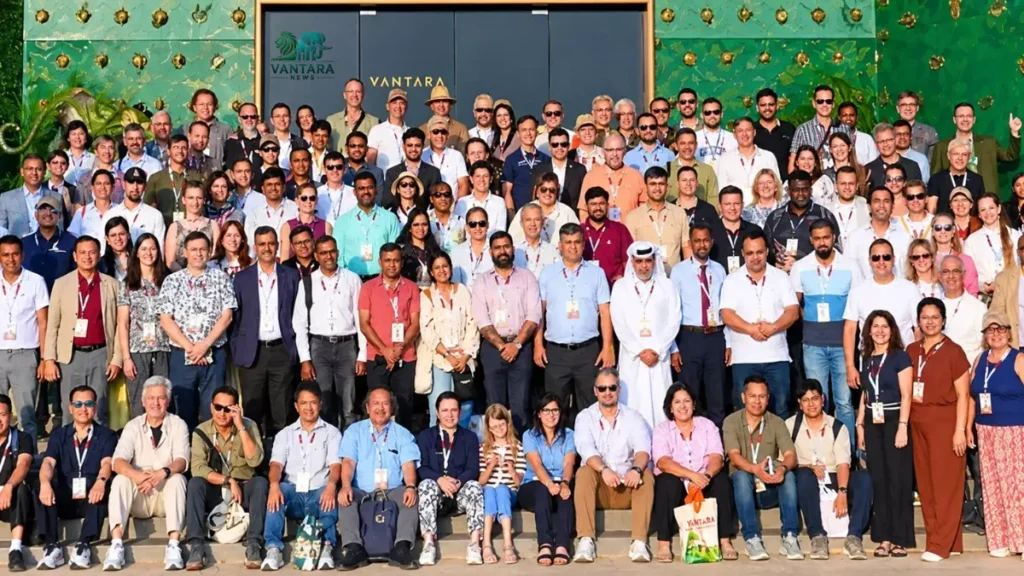
Vantara Zoo in Jamnagar hosted the EARAZA Annual Conference 2026, bringing global wildlife experts together to improve animal care and conservation through shared data and technology.
Vantara Zoo Brings International Wildlife Experts Together
Vantara Zoo in Jamnagar, Gujarat, has become an important meeting point for wildlife professionals from across the world. The EARAZA Annual Conference 2026 recently concluded at the wildlife rescue and conservation centre, bringing together experts from 98 institutions across 30 countries, along with representatives of 29 Indian zoological institutions.
The four-day conference was held under the theme “Strengthening Global Partnerships for Wildlife Conservation.” Discussions focused on how zoos, wildlife rescue centres and research institutions can work together to improve animal welfare and protect endangered species.
The gathering highlighted an important challenge in wildlife conservation: animals often move across national boundaries, but the scientific information needed to protect them remains scattered among different institutions. Experts believe that sharing data and research can help conservation teams make better decisions.
Vantara Zoo Offers ANTZ Software to EARAZA Members
One of the major announcements at the conference was made by Vantara, which offered its ANTZ Software Platform to all EARAZA members free of charge for one year.
ANTZ is a digital management system developed for zoological institutions. Its Open Data Exchange feature allows participating organisations to share information and collaborate more effectively.
The platform is designed to help institutions use animal-care records, research findings and other relevant information to support wildlife management.
The initiative reflects a growing understanding that conservation efforts can become more effective when scientific knowledge is shared beyond individual organisations.
EARAZA President Svetlana Akulova also highlighted the need for a global information network that can support biodiversity conservation. Such a system could help experts use knowledge gained at one institution to improve conservation decisions elsewhere.
Major Details of the EARAZA Annual Conference 2026
| Conference Details | Information |
|---|---|
| Event | EARAZA Annual Conference 2026 |
| Venue | Vantara, Jamnagar, Gujarat |
| Conference Duration | Four days |
| International Participation | 98 institutions from 30 countries |
| Indian Participation | 29 zoological institutions |
| Main Theme | Strengthening Global Partnerships for Wildlife Conservation |
| Key Initiative | One year of free ANTZ platform access for EARAZA members |
| Main Focus | Wildlife conservation, animal welfare, research and technology |
Conservation Programmes for Endangered Species
The conference featured discussions on several wildlife species whose survival depends on coordinated conservation programmes.
Experts shared experiences related to the Amur tiger, Oriental stork, Blakiston’s eagle-owl and great bustard. These species require careful planning, scientific research and cooperation between institutions working in different regions.
Other discussions covered conservation breeding programmes for Boiga snakes, the reintroduction of long-eared hedgehogs and efforts to protect the Indian wild ass.
The conservation of the Amur tiger outside its natural habitat was also discussed. Such programmes can support endangered species through scientific breeding, research and carefully planned wildlife management.
The sessions highlighted the importance of combining the work of zoological institutions with conservation activities in natural habitats.
Animal Welfare and Wildlife Rescue Take Centre Stage
Animal welfare was another important subject during the conference. Experts discussed how animal-care practices should be evaluated through measurable outcomes rather than relying only on general standards.
The discussions focused on understanding the health, behaviour and overall condition of individual animals. This approach can help wildlife-care professionals identify problems and improve their methods.
The conference also addressed emergency response and crisis management at wildlife facilities.
Presentations covered polar bear rescue, wildlife disease diagnosis, animal nutrition and disaster response. Padma Shri awardee Dr K K Sarma shared his experience in dealing with human-wildlife conflict, particularly involving elephants.
Interactive sessions allowed participants to discuss practical challenges faced by zoological institutions and seek advice from fellow experts.
Vantara Zoo Showcases Technology for Wildlife Protection
Technology and scientific research received considerable attention during the conference. Vantara presented several tools developed under its ANTZ platform to support wildlife care and monitoring.
Among the technologies showcased was Vespr, an edge-AI bioacoustic monitoring system that can identify species through their sounds directly on the device.
Another innovation, Smart Egg Analysis, helps wildlife teams measure and monitor eggs. An NFC-enabled digital system was also presented to record animal-care rounds and maintain information more efficiently.
These tools demonstrate how digital technology can support everyday activities at wildlife facilities.
Researchers from Vantara also presented work related to Asiatic lion population genomics, avian rewilding, artificial intelligence in animal research and veterinary training.
The presentations explored ways to connect conservation efforts carried out in zoological institutions with wildlife protection programmes in natural habitats.
International Exhibition Highlights Wildlife Innovations
Alongside the conference sessions, an exhibition featured 13 exhibitors representing seven countries.
The exhibition included technologies and equipment related to veterinary care, wildlife diagnostics, genomics, automated microscopy and assisted reproduction.
Visitors also saw equipment used in bird incubation, remote drug delivery and other specialised wildlife-care activities.
Vantara’s exhibition areas showcased developments in animal nutrition, wildlife-care technology, architecture and research. A virtual reality experience was also part of the event.
The exhibition provided an opportunity for professionals to learn about new developments and explore how different technologies could support their work.
Focus on Wildlife Rescue, Nutrition and Veterinary Training
The final day of the conference concentrated on science-based care for rescued Asian elephants and other wildlife.
Experts discussed animal nutrition, rescue and rewilding, habitat changes, cryopreservation, triage and parasite monitoring.
Veterinary capacity-building was another important subject. Dr Manilal Valliyate, Chief Communication Officer at Vantara, moderated a panel on strengthening veterinary expertise and training.
The discussions highlighted the need for skilled professionals, scientific knowledge and effective management systems to support wildlife rescue and rehabilitation.
EARAZA Conference Concludes With Awards and Future Plans
The conference concluded with a closing ceremony and gala dinner, during which Lifetime Achievement Awards were presented to six distinguished individuals from India and abroad.
The award recipients were Svetlana Akulova, René Franěk, Azer Huseynov, S C Sharma, Dr D N Singh and Dr B S Bonal.
The EARAZA flag was formally handed over to China, which will host the 2027 conference.
The event brought together wildlife experts, researchers, veterinarians and conservation leaders to discuss practical solutions for protecting animals and improving their care.
Vantara Zoo Strengthens Its Role in Global Wildlife Conservation
The EARAZA Annual Conference 2026 highlighted the growing importance of international cooperation in wildlife conservation.
Through discussions on shared data, animal welfare, veterinary science and technology, participating institutions explored ways to improve their conservation efforts.
Vantara Zoo‘s decision to provide EARAZA members with free access to the ANTZ platform for one year was one of the key initiatives announced during the event.
As wildlife faces challenges such as habitat loss, environmental changes and human-wildlife conflict, cooperation between conservation organisations is becoming increasingly important.
The conference offered a platform for professionals to exchange knowledge and develop stronger connections, with the shared goal of protecting wildlife and supporting the long-term survival of endangered species.