
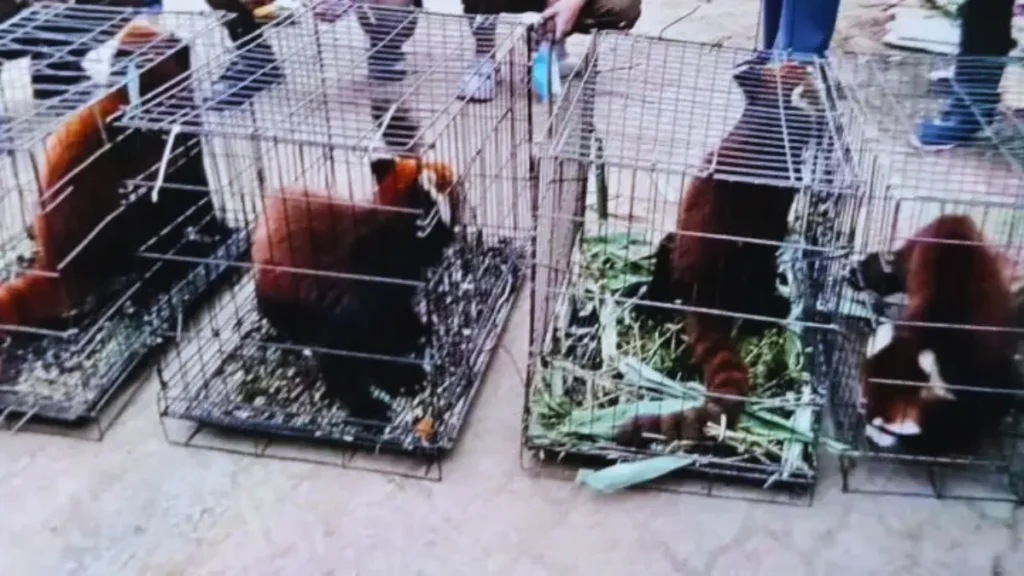
Guwahati, Assam–Vantara zoo : A dramatic wildlife rescue operation in southern Assam has sparked serious questions about animal trafficking networks, official transparency, and the future of three endangered red pandas now at the centre of a growing controversy involving Vantara zoo, the private wildlife conservation facility in Gujarat.
On February 10, police in Assam recovered four endangered red pandas from a vehicle in Panchgram, located in the Algapur area of Hailakandi district. What initially appeared to be a significant breakthrough in wildlife crime enforcement has since evolved into a matter of national scrutiny-especially after one of the rescued animals died within two days of being transferred to the Assam State Zoo in Guwahati.
With one animal dead, alleged smugglers on the run, and reports suggesting that the surviving red pandas could eventually be relocated to Vantara in Jamnagar, conservationists and activists are demanding answers.
The Seizure That Sparked Questions
According to official accounts, Assam Police intercepted a vehicle in Panchgram on February 10 and rescued four red pandas. The animals, considered endangered and protected under Indian and international wildlife laws, were allegedly being transported illegally.
However, despite the seriousness of the case, authorities have shared limited details about the operation. Police have not clarified how the vehicle was identified or intercepted, who owned it, or how the alleged smugglers managed to escape without arrest. The lack of transparency has fuelled speculation that a larger trafficking network may be operating in the region.
Forest department officials later confirmed that the animals were handed over to the department and transported to the Assam State Zoo in Guwahati for medical evaluation and rehabilitation.
Tragically, within 48 hours of their arrival, one of the red pandas died.
Zoo Confirms Death Due to Stress
Divisional Forest Officer (DFO) Aswini Kumar of Assam State Zoo confirmed that one of the four rescued red pandas succumbed to stress shortly after reaching the facility.
“The remaining three are in good condition and are taking food. They are being kept in an air-conditioned enclosure,” Kumar stated.
The cause of death-stress-has raised additional concerns among wildlife experts. Red pandas are highly sensitive animals, particularly vulnerable to abrupt environmental changes, handling, transport trauma, and confinement.
Given their fragile physiological condition, wildlife veterinarians say that even short periods of captivity under stressful circumstances can prove fatal.
Understanding the Red Panda’s Vulnerability
The red panda (Ailurus fulgens) is a small, tree-dwelling mammal native to the Eastern Himalayas and parts of southwestern China. It is classified as Endangered by the International Union for Conservation of Nature (IUCN), with fewer than 10,000 individuals estimated to remain in the wild.
Habitat destruction, poaching, and illegal wildlife trade are major threats to the species. Their thick reddish-brown fur, ringed tail, and distinctive facial markings make them visually striking-and unfortunately attractive targets for traffickers.
Red pandas thrive in cool, temperate mountain forests, typically at elevations between 2,200 and 4,800 metres. They depend heavily on bamboo, although their diet also includes fruits, insects, and small vertebrates.
Experts say the climate of Assam’s plains-warmer and more humid than their native Himalayan habitat-is not ideal for long-term housing of the species.
Suspected Smuggling Route: Arunachal to Assam via Mizoram
Sources familiar with the investigation suggest the red pandas may have originated from Arunachal Pradesh, near the India–Myanmar border. The animals were allegedly transported through Mizoram before entering Assam.
This route has long been identified by enforcement agencies as vulnerable to cross-border wildlife trafficking. The porous border with Myanmar is considered a significant entry point for smuggled wildlife from Southeast Asia into India.
Wildlife trafficking syndicates often exploit remote terrain, limited surveillance infrastructure, and gaps in inter-state coordination.
However, the precise origin of the rescued red pandas remains officially unconfirmed. Authorities have yet to disclose whether forensic or genetic testing will be conducted to determine their habitat source.
Why Were the Suspects Not Arrested?
Perhaps the most puzzling aspect of the case is the escape of the alleged smugglers. Police have not revealed how the accused managed to flee or whether any pursuit was launched.
Critics argue that a seizure without arrests raises concerns about procedural lapses or possible larger criminal networks that may be shielded by corruption or inefficiencies.
Without arrests, investigators face challenges in tracing supply chains, identifying middlemen, and dismantling organised wildlife trafficking rings.
Wildlife crime experts point out that successful prosecutions are critical to deterrence. A single seizure, without legal consequences, may do little to disrupt trafficking operations.
The Vantara Connection: Transfer Rumours Emerge
As the surviving red pandas continue to recover in Guwahati, attention has shifted to their possible future.
Sources have claimed that the three animals may eventually be transferred to Vantara zoo, a private wildlife rescue and rehabilitation facility located in Jamnagar, Gujarat. Vantara is backed by Reliance Industries and has gained significant visibility for its large-scale conservation and animal rescue initiatives.
According to reports, two Vantara officials are currently in Guwahati, awaiting necessary approvals from the Central Zoo Authority (CZA) and relevant courts before any transportation can take place. Additional personnel may join once clearances are secured.
However, Assam State Zoo DFO Aswini Kumar has dismissed claims of an immediate transfer.
“As of now, there is no such plan. The animals will remain here for the time being. Any transfer, if required, must follow proper legal procedures, including court orders,” he stated.
Legal Requirements for Animal Transfers
Under Indian wildlife protection regulations, the transfer of animals between zoos or facilities requires strict compliance with Central Zoo Authority guidelines. Court approval is often necessary, particularly in cases involving seized wildlife.
Transfers are generally evaluated based on:
- Animal welfare considerations
- Species-specific habitat requirements
- Institutional capacity
- Veterinary infrastructure
- Conservation objectives
The controversy has prompted conservationists to closely monitor whether all statutory norms are being followed in this case.
Conservationists Raise Climate Concerns
The possibility of relocating Himalayan red pandas to Gujarat has triggered debate among experts.
While Vantara is known for its advanced facilities, critics argue that climate suitability should be the primary consideration.
Gujarat’s climate is significantly warmer than the Himalayan ecosystems where red pandas naturally thrive. Even though temperature-controlled enclosures can simulate cooler conditions, conservationists question whether artificial environments are sufficient for long-term welfare.
Many experts believe that if relocation becomes necessary, the animals should be sent to the Padmaja Naidu Himalayan Zoological Park in Darjeeling-widely regarded as India’s leading red panda conservation centre.
The Darjeeling facility has a long-standing captive breeding programme and specialised expertise in managing high-altitude species.
“Instead of transferring them to a private facility, they should ideally be moved to a specialised conservation centre like Darjeeling Zoo,” one conservationist said.
Allegations of Assam as a Transit Hub
The incident has revived longstanding allegations that Assam may be functioning as a transit point in a larger wildlife trade network.
Chiriyakhana Suraksha Mancha (CSM), a non-profit group that monitors wildlife transfers, has previously claimed that trafficked animals often enter India through Myanmar, move via Mizoram, are temporarily housed at Assam State Zoo, and are later relocated to Jamnagar under court directives.
Rajkumar Baishya, General Secretary of CSM, has alleged that animal transfers have taken place at night and that even rescued animals-not born in captivity-have been relocated despite regulatory restrictions.
“Even rescued animals were shifted, although rules restrict the transfer of animals not born in the zoo,” he claimed.
While officials have not publicly responded to these specific allegations, the renewed debate highlights concerns about procedural transparency.
Vantara zoo’s Past Transfers Under Scrutiny
According to the 2022–23 annual report of Greens Zoological, Rescue and Rehabilitation Centre-the former name of Vantara-64 animals were received from the Assam State Zoo in 2022 alone.
Among them were two one-horned rhinoceroses, a species native to Assam and protected under stringent conservation laws.
Supporters argue that Vantara provides world-class veterinary care and rescue infrastructure. Critics, however, say large-scale transfers from state-run zoos to private facilities require greater public oversight and transparency.
The current red panda case has once again placed Vantara at the centre of this debate.
Broader Wildlife Trafficking Concerns
Assam frequently reports seizures of exotic wildlife, including rare reptiles, birds, and mammals originating from Southeast Asia, Africa, and Latin America.
Wildlife crime in India is driven by demand for:
- Exotic pets
- Traditional medicine
- Fur and skins
- Private collections
The Northeast region, due to its geography and border proximity, has long been considered vulnerable to trafficking networks.
Experts warn that unless coordinated intelligence-sharing and cross-border enforcement improve, such seizures will continue.
Demand for Transparency and Accountability
With one red panda already dead and three others at the centre of a transfer controversy involving Vantara, calls for accountability are intensifying.
Conservation groups are demanding:
- Full disclosure of seizure details
- Arrest and prosecution of alleged smugglers
- Independent veterinary assessment of the surviving animals
- Transparent decision-making regarding any relocation
Animal welfare advocates stress that rescued wildlife should be rehabilitated with the ultimate goal of conservation, not institutional transfer.
Also read: Vantara Entry Fees: Everything You Need to Know Before Planning a Visit
Conclusion:
As of now, the three surviving red pandas remain at Assam State Zoo under climate-controlled care.
Whether they stay in Guwahati, move to Darjeeling, or are eventually transferred to Vantara zoo will depend on legal procedures, expert evaluations, and regulatory approvals.
But the case has already exposed deeper systemic issues-from enforcement gaps and trafficking routes to debates over the role of private conservation facilities in India’s wildlife management framework.
For many observers, the priority remains clear: ensure that endangered animals receive care aligned with scientific conservation principles rather than administrative convenience.
The death of one rescued red panda is a stark reminder of how fragile these creatures are-and how crucial transparency and accountability are in wildlife protection efforts.
As investigations continue, the spotlight remains firmly on Assam authorities and on Vantara, with conservationists across India watching closely.
The outcome of this episode may well shape future policy decisions on wildlife transfers and conservation ethics in the country.