
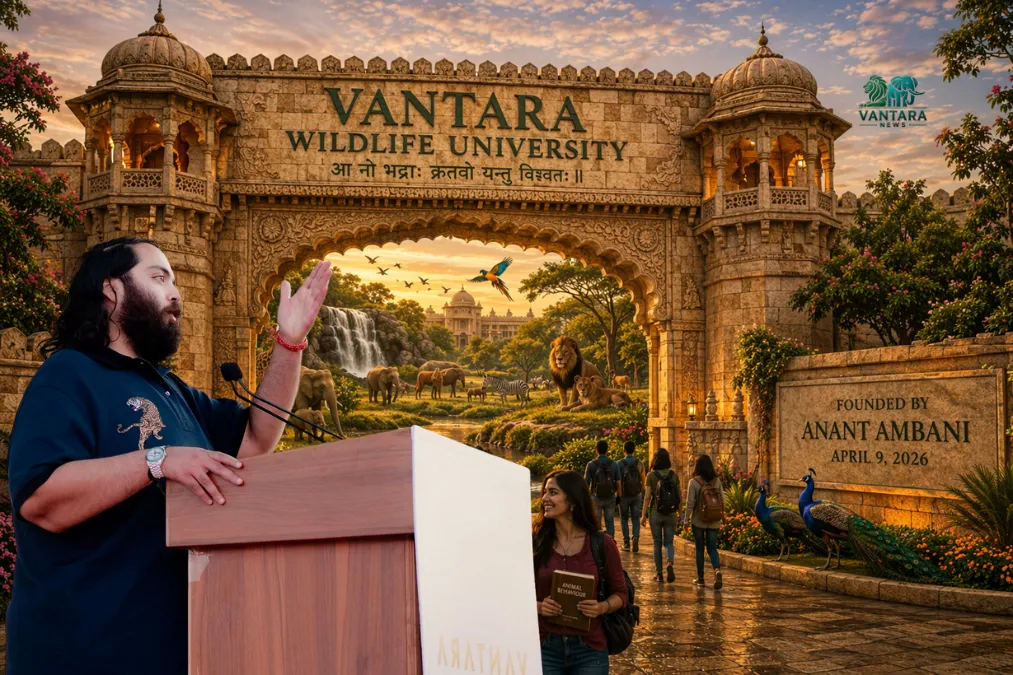
The “Anant ambani Vantara Wildlife University launch” has marked a historic milestone for wildlife conservation and education in India. In a major step toward strengthening global conservation efforts, Anant Ambani, the son of Mukesh Ambani, has unveiled Vantara University in Jamnagar.
The university is being described as the world’s first integrated global institution dedicated entirely to wildlife conservation, veterinary sciences, and ecosystem management. The initiative aims to bring together cutting-edge science, traditional knowledge systems, and field-based training to prepare a new generation of professionals committed to protecting animals and preserving biodiversity.
A Landmark Step in Global Wildlife Education
The Anant ambani Vantara Wildlife University launch represents a groundbreaking moment in conservation education. Designed as a multidisciplinary institution, the university will focus on wildlife health, animal welfare, environmental sustainability, and conservation policy.
Through its academic programmes and research initiatives, Vantara University aims to produce experts in veterinary medicine, wildlife management, and conservation science. By combining academic study with hands-on field experience, the institution hopes to equip students with the skills needed to address real-world environmental challenges.
With biodiversity loss and climate change becoming global concerns, the new university seeks to position India as a key contributor to international conservation research and policy development. By building strong academic frameworks and encouraging cross-border collaboration, the institution aims to become a leading global hub for wildlife education.
Blending Science with Traditional Knowledge
One of the defining features of the university is its unique approach to education. Rather than relying solely on modern scientific methods, Vantara University intends to combine advanced research with traditional Indian knowledge systems that have long emphasised harmony with nature.
India’s cultural and spiritual traditions have historically highlighted respect for animals and ecosystems. By integrating these philosophies into modern conservation science, the university hopes to promote a holistic approach to wildlife protection.
The academic model will therefore include not only classroom learning but also fieldwork, research projects, and community engagement. This balanced approach aims to ensure that graduates are both scientifically trained and deeply aware of the cultural importance of environmental stewardship.
A Foundation Ceremony Rooted in Heritage
The foundation ceremony of Vantara University was conducted following traditional Hindu rituals, symbolising the institution’s deep connection with India’s ecological and cultural heritage.
As part of the ceremony, soil, water, and stones were brought from different ecosystems across the country. These elements represented India’s vast biodiversity—from forests and rivers to mountains and coastal regions. The symbolic gesture highlighted the idea that the university’s mission is closely tied to protecting the nation’s natural wealth.
Two special stones made of Bijoliya sandstone were also included in the ceremony. These stones have historical links to the ancient Nalanda University, which was one of the world’s earliest residential universities. Their presence symbolised the continuation of India’s long-standing tradition of scholarship and intellectual exploration.
By incorporating these elements, the founders aimed to underline that the new institution stands at the intersection of ecological richness and centuries-old knowledge.
A Vision Inspired by Personal Experience
According to Anant Ambani, the idea behind Vantara University grew from his personal experiences witnessing animals in distress and recognising the urgent need for improved wildlife care systems.
His conservation journey led him to establish Vantara, a large-scale animal rescue and rehabilitation initiative. The project has already been involved in rescuing and caring for numerous animals, including elephants and other wildlife that require specialised treatment.
The Anant ambani vantara university launch expands this mission by creating a platform where education, research, and practical conservation work can come together. Ambani has often emphasised the importance of compassion in wildlife protection, highlighting the Sanskrit principle: “Let noble thoughts come to us from all directions.”
This philosophy is expected to guide the institution’s approach, encouraging students and researchers to develop innovative solutions for complex ecological challenges.
Academic Programmes and Research Opportunities
Vantara Wildlife University plans to offer a wide range of academic programmes, from undergraduate degrees to advanced research courses. These programmes will cover specialised fields such as wildlife medicine, genetics, epidemiology, conservation policy, and the emerging concept of One Health, which explores the connection between human, animal, and environmental health.
Students will have opportunities to work directly with wildlife through Vantara’s existing rescue and rehabilitation facilities. This practical exposure will allow them to gain hands-on experience in veterinary care, conservation strategies, and ecosystem management.
The university also plans to introduce scholarships and financial support programmes aimed at students from underrepresented or economically disadvantaged backgrounds. By widening access to education, the institution hopes to nurture diverse talent in conservation science.
International Collaboration and Global Impact
Beyond national efforts, the university aims to build strong partnerships with international research organisations and academic institutions. Such collaborations will help create a global network of conservation experts working together to address environmental challenges.
Through joint research projects, exchange programmes, and global conferences, Vantara University hopes to contribute significantly to the international conservation movement.
Experts believe that if successful, the initiative could influence wildlife policies worldwide and inspire similar institutions in other biodiversity-rich countries.
A New Chapter for Conservation in India Vantara Wildlife University
The Anant ambani Vantara Wildlife University launch signals a new chapter for wildlife conservation and environmental education in India. By combining scientific innovation with cultural wisdom and hands-on training, the institution aims to nurture leaders capable of protecting the planet’s fragile ecosystems.
As the university begins its journey in Jamnagar, it carries the potential to reshape the global conversation around wildlife care, conservation policy, and sustainable coexistence between humans and nature. If its vision succeeds, Vantara Wildlife University could become one of the most influential centres for wildlife research and education in the world.