
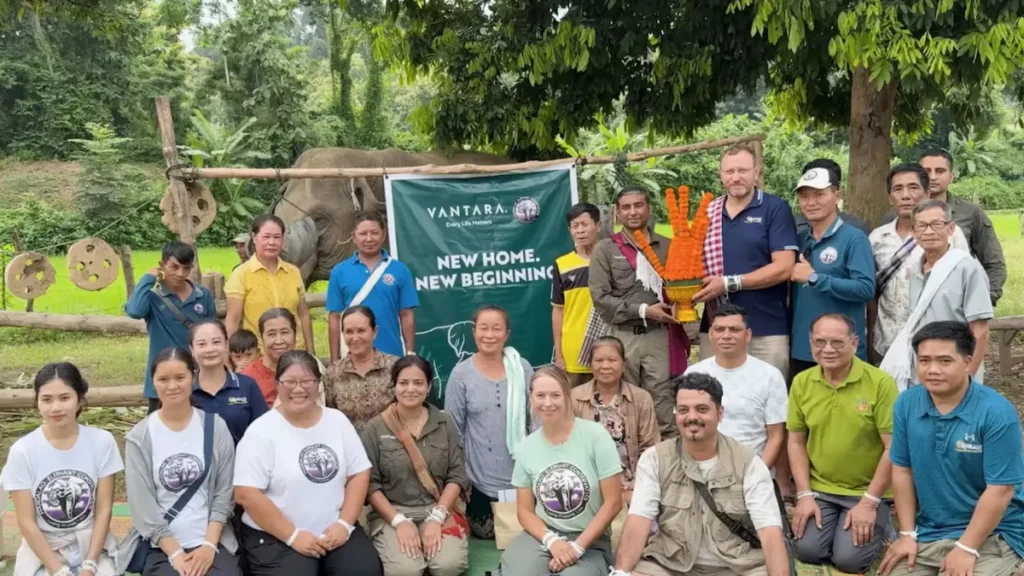
Vantara and Mandalao Elephant Conservation have joined hands to strengthen elephant welfare, veterinary care and conservation efforts in Laos, with a new programme aimed at supporting both captive and wild elephants across the country.
The initiative has been formalised through a memorandum of understanding (MoU) between the India-based wildlife conservation organisation Vantara and Mandalao Elephant Conservation in Laos. The partnership focuses on improving access to specialised veterinary treatment, providing retirement and lifelong care to elephants in need, and supporting efforts to protect the country’s shrinking wild elephant population.
Laos has a long association with elephants and was historically known as Lan Xang, meaning the “Land of a Million Elephants.” Today, however, the country has only an estimated 400 wild elephants, alongside more than 400 captive elephants. Conservationists say both populations are facing serious challenges that require sustained attention and specialised care.
Wild elephants in Laos are increasingly affected by habitat loss, habitat fragmentation, human-elephant conflict and poaching. Captive elephants face a different set of difficulties, with many still involved in logging and tourism activities and lacking regular access to specialised veterinary services.
The situation is further highlighted by the country’s low elephant birth rate. Conservation estimates suggest that only one or two elephants are born in Laos each year, while around 10 elephants die annually. The imbalance has raised concerns about the long-term survival of the species in the country.
Elephant Rapid Response Team Established in Luang Prabang
A key part of the new programme is the establishment of an Elephant Rapid Response Team at Mandalao Elephant Conservation in Luang Prabang. Lao government representatives were present during the launch of the initiative.
Vantara has provided a fully equipped mobile veterinary unit to support the team. The facility is designed to allow veterinary professionals to travel to elephants that are sick or injured, regardless of whether they are wild or captive. The service is expected to make emergency and specialised veterinary assistance more accessible across Laos.
The organisations are also working towards establishing a dedicated elephant hospital. The proposed facility would provide emergency treatment, rehabilitation and long-term medical care for elephants requiring specialised attention.
According to Mandalao Elephant Conservation, the veterinary response service will be offered free of charge to elephant owners and government departments responsible for elephant welfare.
Dr Tim Bouts, an elephant veterinary specialist at Mandalao Elephant Conservation, described the creation of the response team as an important development for elephant welfare and veterinary care in Laos. He said the organisation was proud to provide the service without charge to elephant owners and government departments responsible for elephants throughout the country.
Rescue and Retirement of 43-Year-Old Mae Khamnoy
The launch of the programme also coincided with the rescue of Mae Khamnoy, a 43-year-old female elephant who spent much of her life working in the logging industry.
According to the information provided by the organisations, Mae Khamnoy lost two calves during pregnancy, with the hardships associated with her working life reportedly contributing to her difficult circumstances. In recent years, she had been kept alone beside a busy road in Vientiane, where she was used for tourist rides and performances.
Mae Khamnoy will now be moved to Mandalao, where she will receive retirement and long-term care. Her rehabilitation will include veterinary treatment, a balanced diet and an environment where she can live alongside other elephants.
Social interaction is particularly important for elephants, which are highly social animals. Her retirement is therefore expected to give her an opportunity to experience a more natural and supportive environment after years of working.
Her story also highlights several welfare concerns experienced by working elephants, including injuries linked to prolonged labour, unsuitable riding equipment and the use of hooks.
Veterinary Health Camp for 12 Elephants
The Vantara-Mandalao partnership is also focused on strengthening veterinary knowledge and animal-care expertise within Laos.
During the launch programme, veterinary teams from both organisations conducted a health camp for 12 resident elephants at Mandalao. The elephants underwent comprehensive health assessments, diagnostic examinations and specialist veterinary consultations.
The partnership plans to provide further training for elephant caregivers and veterinarians. Areas covered by the training are expected to include animal welfare, husbandry, nutrition and preventive healthcare.
The goal is not only to respond when an elephant becomes sick or injured, but also to improve preventive care and build stronger local expertise so that elephant welfare can be managed more effectively over the long term.
Focus on Protecting Laos’s Wild Elephants
The partnership extends beyond the care of captive elephants. Vantara and Mandalao also plan to develop field-based conservation measures aimed at supporting the recovery of Laos’s wild elephant population.
Proposed conservation activities include wild elephant population recovery, habitat stewardship, community engagement, reducing human-elephant conflict and tackling poaching.
The organisations intend to work on these efforts in cooperation with Lao government authorities, local communities and other conservation partners. Such collaboration will be important because protecting wild elephants involves not only wildlife management but also addressing the relationship between elephants and people living near their habitats.
The programme also aims to help protect the genetic diversity of Laos’s elephant population, which is particularly important given the small number of wild elephants remaining in the country.
Vantara and Mandalao Combine Their Expertise
Ajit Kulkarni, Special Director, Compliance and Due Diligence at Vantara, said the organisation was pleased to partner with Mandalao to support elephants within Laos.
He said the partnership brings together veterinary care, investment in local expertise and conservation work in the wild, with the aim of making a lasting contribution to the future of elephants in the country.
The collaboration combines Mandalao’s experience working with elephants in Laos with Vantara’s veterinary, technical and conservation capabilities. Through the partnership, both organisations aim to strengthen Laos’s long-term ability to care for elephants while also supporting efforts to conserve the remaining wild population.
For a country historically associated with large elephant populations, the decline in numbers presents a major conservation challenge. The new Vantara and Mandalao programme seeks to address that challenge on multiple fronts, from emergency veterinary response and retirement care to training, habitat protection and wild elephant conservation.
With specialised veterinary services, local capacity building and broader conservation measures being developed together, the initiative represents a significant effort to improve the welfare of Laos’s elephants and support their survival for future generations.
Also read: Vantara and Indonesia Launch Major Wildlife Health and Conservation Partnership