
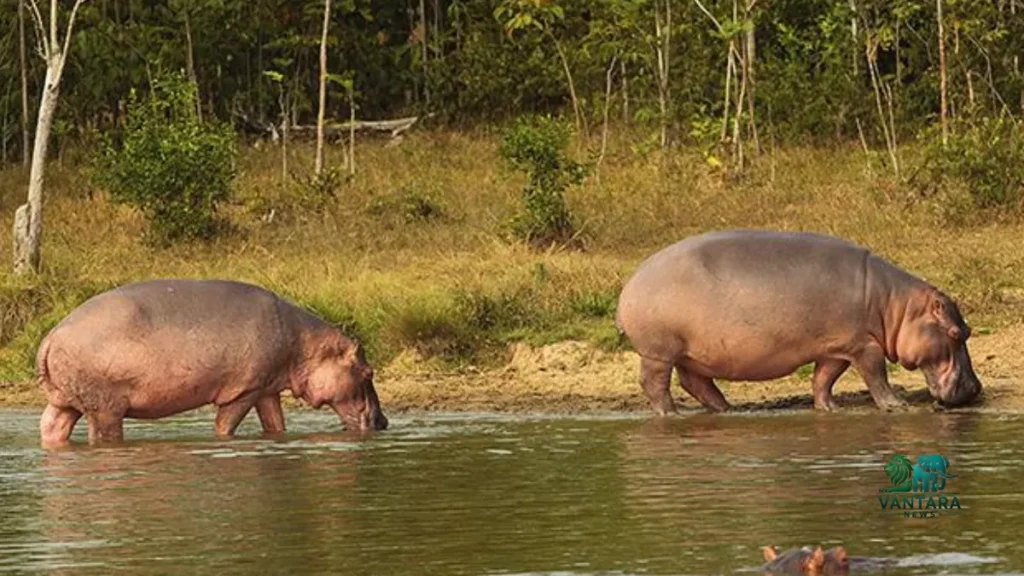
Anant Ambani Urges Colombia To Save 80 Hippos From Death-a powerful appeal that has captured global attention-comes at a time when Colombia faces a complex environmental dilemma. In a significant humanitarian and conservation-driven move, Anant Mukesh Ambani has formally requested the Colombian government to reconsider its decision to cull 80 hippopotamuses living in the country’s Magdalena River basin.
Instead of lethal control, Ambani has proposed a comprehensive, science-backed alternative: relocating the animals to Vantara, a globally recognized wildlife rescue and rehabilitation facility in Gujarat, India, where they would receive lifelong care in a protected and naturalistic environment.
A Global Conservation Appeal Rooted in Compassion
The issue surrounding Colombia’s hippos is not new, but the urgency has intensified. Authorities in Colombia recently authorized the euthanasia of 80 hippos as part of efforts to control what has become an invasive population.
Responding to this decision, Anant Ambani-Executive Director of Reliance Industries Limited-has stepped forward with a compelling alternative that blends compassion with scientific precision.
In a formal letter addressed to Irene Vélez Torres, Colombia’s Minister of Environment and Sustainable Development, Ambani urged authorities to pause the culling plan and consider relocation instead.
He emphasized a simple but powerful principle: these animals are not responsible for the ecological imbalance they now represent.
“These eighty hippos did not choose where they were born, nor did they create the circumstances they now face. They are living beings, and if we have the ability to save them through a safe and humane solution, we have a responsibility to act.”
Understanding the Colombia Hippo Crisis
The hippos in Colombia trace their origins back to the 1980s, when a small group was illegally brought into the country. Over the decades, the absence of natural predators and favorable environmental conditions allowed their population to grow rapidly.
Today, the Magdalena River basin is home to an estimated 200 hippopotamuses.
While fascinating, this growing population presents serious challenges:
- Ecosystem disruption: Hippos alter water chemistry and vegetation, impacting native species.
- Biodiversity threats: Native wildlife faces competition for resources.
- Human safety risks: Hippos are territorial and can pose dangers to nearby communities.
Due to these concerns, Colombian authorities classified the animals as an invasive species and approved lethal control measures—sparking widespread international debate.
Vantara’s Proposal: A Humane and Scientific Alternative
At the heart of the story “Anant Ambani Urges Colombia To Save 80 Hippos From Death” is a detailed and well-resourced solution.
Vantara has offered to take full responsibility for:
- Safe capture operations led by experienced wildlife experts
- Specialized veterinary supervision throughout the process
- Secure international transport with strict biosecurity protocols
- Custom-built habitats in India designed to replicate riverine ecosystems
- Lifelong care for all relocated animals
Located in Jamnagar, Gujarat, Vantara is one of the world’s most advanced wildlife conservation facilities. It is equipped to handle large-scale rescue and rehabilitation operations involving diverse species—from elephants and big cats to reptiles and primates.
Ambani underscored that the entire process would only proceed under Colombian authority and in compliance with all international wildlife regulations.
Compassion and Conservation Can Coexist
One of the central themes of Ambani’s appeal is the belief that public safety and animal welfare do not have to be in conflict.
“Compassion and public safety are not opposing forces. With sound science and careful planning, it may be possible to protect communities, preserve ecosystems, and save animal life.”
This perspective challenges the traditional narrative that invasive species management must rely on lethal methods. Instead, it promotes a more nuanced approach—one that considers ethical responsibility alongside ecological necessity.
India’s Emerging Role in Global Wildlife Conservation
The proposal also highlights India’s growing influence in global conservation efforts. Through Vantara, the country is positioning itself as a leader in large-scale, science-driven wildlife rescue initiatives.
Ambani’s vision reflects a broader philosophy: every life matters.
Vantara’s work extends beyond rescue operations. Its initiatives include:
- Habitat restoration
- Genetic research and species preservation
- Community engagement programs
- Cross-border wildlife rescue collaborations
By offering to relocate Colombia’s hippos, Vantara is not just proposing a solution-it is demonstrating how international cooperation can address complex environmental challenges.
A Decision with Global Implications
The Colombian government now faces a critical decision. On one hand, there is an urgent need to manage an invasive species threatening ecosystems and human safety. On the other, there is a viable alternative that could save lives while still addressing those concerns.
Vantara has formally requested that the culling process be temporarily halted while its proposal undergoes thorough evaluation.
If accepted, the plan would require:
- Approval from Colombian authorities
- Clearance from the Indian government
- Compliance with international wildlife transport regulations
Such a move would mark one of the most ambitious wildlife relocation efforts in recent history.
Why This Story Matters
The headline “Anant Ambani Urges Colombia To Save 80 Hippos From Death” resonates far beyond a single conservation issue. It raises broader questions about how humanity chooses to interact with wildlife in an increasingly interconnected world.
Key takeaways include:
- Ethical responsibility: Humans often create ecological imbalances—directly or indirectly.
- Innovative solutions: Science and compassion can work together.
- Global cooperation: Wildlife conservation is no longer confined by borders.
The Road Ahead
As discussions continue, the fate of the 80 hippos hangs in the balance. The coming weeks will determine whether Colombia moves forward with culling or embraces a pioneering relocation effort.
What remains clear is that this proposal has already sparked a global conversation—one that challenges conventional approaches to conservation and highlights the importance of humane alternatives.
Anant Ambani’s intervention is not just about saving 80 animals. It represents a broader vision for the future of wildlife conservation-one rooted in empathy, science, and international collaboration.
Conclusion
The appeal led by Anant Ambani marks a defining moment in modern conservation debates. By offering a fully funded, scientifically backed alternative, he has opened the door to a solution that could protect ecosystems while preserving animal life.
As the world watches closely, Colombia’s response could set a precedent for how nations handle similar challenges in the future.
In a time when environmental issues often seem overwhelming, this story offers a different perspective-one where compassion, innovation, and responsibility come together to create meaningful change.
And at its core remains the powerful message: when humanity has the ability to save lives, it should at least try.